
Mid-Block Crosswalk Safety: The Brandon University Fix Every City Needs

When a Dangerous Crossing Finally Gets Fixed
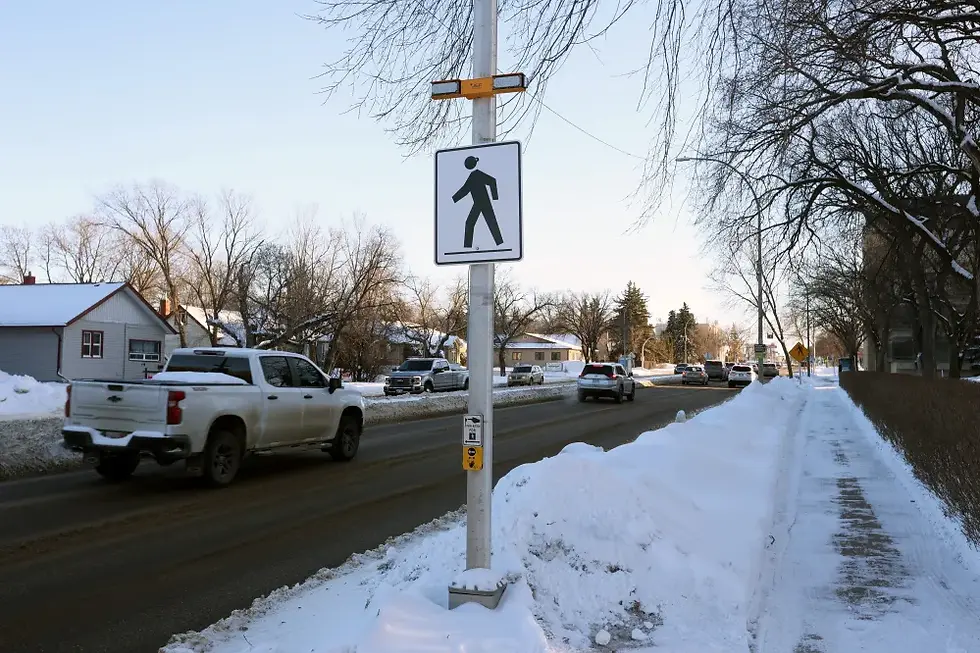
For years, pedestrians crossing 18th Street at Lorne Avenue near Brandon University in Brandon, Manitoba, took a calculated risk every single time they stepped off the curb. The intersection sits on one of the city's busiest thoroughfares, with high traffic volumes, multi-lane traffic flow, and no crosswalk lighting. The crossing was marked by signage alone, and that was not enough. Near-misses were routine. Complaints accumulated. As a recent opinion piece in the Brandon Sun put it, the community had been waiting a long time for action at this dangerous intersection. The community knew something had to change, but change moved slowly, as it often does when infrastructure funding, intergovernmental coordination, and competing priorities converge.
Then in February 2026, the situation finally shifted. Through a collaborative effort between Brandon University, the City of Brandon, and Manitoba Transportation and Infrastructure, three sets of rectangular rapid flashing beacons were installed at the crossing, transforming a chronically dangerous location into a measurably safer one almost immediately. The province's investment was part of a broader $10 million upgrade to 18th Street, and the beacons were among the most visible and practical elements of that work.
The Brandon story is not unique. It plays out in communities across North America every year. A crossing is dangerous for a long time. People speak up. Studies are done. Budgets are discussed. Eventually, when the political will and the funding align, technology gets deployed. What is worth examining is why RRFB technology specifically keeps rising to the top of those conversations, and what municipalities considering similar upgrades need to understand before they move forward. Mid-block crosswalk safety challenges like Brandon's are more common than most cities want to admit, and the solutions are more accessible than many planners realize.
Pedestrian Crossing Technology Has Changed the Equation
For decades, the primary tools available to traffic engineers at unsignalized crossings were paint, signs, and overhead lighting. These measures helped, but they had a fundamental limitation: none of them changed driver behavior in real time. A painted crosswalk indicates where pedestrians cross. A warning sign reminds them that pedestrians have the right of way. But neither generates an active, in-the-moment alert that interrupts driver attention and compels yielding behavior.

Pedestrian crossing technology has evolved substantially to close that gap. Today, municipalities have access to pedestrian-activated systems that place dynamic visual alerts directly in the driver's cone of vision, synchronized across the full width of a crossing, and capable of operating autonomously without any connection to the electrical grid. The result is a fundamentally different driver experience at the crosswalk. Instead of passive signage that can be ignored, drivers encounter pulsing, irregular LED flashing that registers as an urgent warning.
The data support what the Brandon community could see with their own eyes after installation. Studies have shown that properly deployed RRFB crosswalk systems can increase driver yielding rates to pedestrians by up to 96 percent at unsignalized crossings. That number is not a marginal improvement. It represents the difference between a crossing that drivers routinely ignore and one where compliance becomes the norm.
RRFB Crosswalks: The Science Behind the Flash

Understanding why rectangular rapid flashing beacons outperform older technologies requires a brief look at how they work. RRFB crosswalks use dual LED light bars mounted in a horizontal rectangular pattern, positioned at or near the driver's eye level, typically on the signage itself. When a pedestrian activates the system, either through a push button, a wave detection sensor, or a passive activation trigger, the beacons begin flashing in a rapid, irregular pattern designed to distinguish them from normal traffic signals.
That irregularity is intentional. Standard traffic signals operate on predictable cycles, and experienced drivers can mentally tune them out. The erratic pulse of an RRFB does not fit any familiar pattern, which means the visual system processes it as an anomaly requiring attention. The MUTCD 11th Edition, published in 2023, formally incorporated rectangular rapid flashing beacons as a recognized traffic control device, validating what years of field research had already demonstrated about their effectiveness.
RRFB crosswalks are particularly well-suited to the most challenging crossing environments: mid-block locations, unsignalized intersections, multi-lane arterials, and crossings near schools, universities, or transit stops where pedestrian volumes are high, and driver expectations are low. The Brandon installation at 18th and Lorne checked nearly every one of those boxes, which is precisely why the technology was the right choice.
Flashing Crosswalk Lights and the Vision Zero Framework
Municipal planners and traffic engineers advancing Vision Zero commitments understand that achieving zero pedestrian fatalities requires moving beyond reliance on driver compliance with static signage. Flashing crosswalk lights represent one of the most cost-effective tools available for reducing fatality risk at crossings where pedestrians are most vulnerable: unsignalized, multi-lane roads with moderate to high speed limits.
The Brandon police made this point directly when the new system went live. Inspector Jason Dupuis of the Brandon Police Service called the installation an important step in improving pedestrian and traffic safety at a high-risk area, and noted that measures like this help reduce close calls and collisions. Sam van Huizen, the City of Brandon's Traffic and Transportation Planner, framed it explicitly within the Vision Zero framework, describing the RRFBs as part of an ongoing commitment to road safety.
That framing matters for Public Works Directors and planning committees evaluating infrastructure investments. Flashing crosswalk lights are not simply an amenity. They are a demonstrable risk reduction tool with a documented evidence base, formal recognition in the MUTCD, and real-world outcomes that support the core goal of eliminating traffic fatalities over time.
Mid-Block Crosswalk Safety and the Case for Crosswalk Beacons
One of the persistent challenges facing municipal traffic safety programs is the tension between the scale of the safety problem and the limits of available capital budgets. Full signalization of every high-risk crossing is often not financially or logistically feasible. Crosswalk beacons, and specifically solar-powered flashing beacon systems, offer a path to meaningful mid-block crosswalk safety improvement at a fraction of the cost of conventional signalized intersections.
JSF Technologies, a leading manufacturer of crosswalk lighting and illumination systems for more than two decades, has developed its AB Series to address this challenge. The AB Series encompasses the full range of pedestrian-activated crosswalk solutions, from traditional traffic beacon systems to RRFB crosswalk light bars and LED-embedded signage. Each product in the line is designed around the same core principle: delivering MUTCD-compliant, high-visibility warning technology in a self-contained package that requires no trenching, grid connection, or ongoing electricity costs.
This architecture has direct implications for municipal budgets. Because each unit in a JSF AB Series system is a solar-powered flashing beacon, installation does not require road closures for conduit work, electrical permitting, or utility coordination. A two-lane crossing typically requires only a pair of back-to-back RRFB units.
Larger four-lane roads may add a median-mounted unit. Installation can often be completed by a crew of one to three people without disrupting traffic flow, which further reduces project costs and community impact.
For budget-constrained Public Works departments, this means that RRFB crosswalk deployments can be scoped, approved, and completed on a timeline that would be impossible for conventional signalized infrastructure. It also means that the program can scale. Rather than committing the full capital budget to a single signalized intersection, a department can deploy crosswalk beacons at multiple high-priority locations within the same budget cycle.
Solar Powered Flashing Beacon Technology Built for Reliability
Municipal infrastructure is expected to perform in conditions that would challenge consumer-grade equipment. Extreme temperature ranges, high humidity, icing, exposure to vandalism, and decades-long service-life expectations set a demanding bar for any crosswalk beacon system. JSF Technologies has engineered its solar-powered flashing beacon products with those conditions explicitly in mind.

The AB Series beacons mount the solar engine, battery, and control electronics at the top of the pole, placing them out of reach and beyond the primary vandalism zone. The solid aluminum enclosures with powder-coated finishes are built for long-term weather resistance. The WP6 Wireless Signal and Lighting Controller, which is standard across the AB Series, provides system management capability including remote scheduling, health monitoring, and alert notifications via text or email when power or component issues are detected. This means maintenance teams do not need to physically inspect each unit on a regular cycle. The system reports its own status.

The wireless spread-spectrum radio communication between units eliminates the need for buried cabling between opposing beacons at a crossing, thereby removing a significant source of long-term maintenance complexity. Wireless range exceeds 1 mile with line of sight, giving engineers the flexibility to place advanced-warning crosswalk beacons on high-speed corridors where drivers need additional reaction distance.
Traffic Calming Solutions for School Zones
Beyond standard crosswalk applications, municipalities increasingly face the challenge of managing pedestrian safety in environments that require time-based activation rather than on-demand triggering. School zone flashing lights represent the most common and most safety-critical version of this challenge. Traffic calming solutions in school zones require scheduling precision, remote management capability, and hardware reliability that holds up across years of daily operation.

JSF Technologies addresses this with a fully integrated scheduling system built into the AB Series architecture. School zone flashing lights in the JSF ecosystem operate on programmatic schedules that can be set, adjusted, and monitored remotely through the internet-based scheduling interface. The primary beacon controls all secondary beacons within the system, coordinating flash sequences across the full zone without requiring manual activation or on-site management.
This capability proved valuable at West Niagara Secondary School in the Niagara Region, where a JSF AB Series RRFB crosswalk installation was completed to protect the hundreds of students crossing Main Street daily. The solution addressed a significant pedestrian safety challenge on a busy arterial road, commanding driver attention during school arrival and dismissal periods while remaining adaptable to schedule changes due to weather or school calendar variations.
For school districts and municipalities managing multiple school zones within a jurisdiction, the ability to remotely manage flashing schedules, receive automated alerts, and adjust programming without sending crews to each site represents a substantial operational efficiency gain. The 50 to 70 percent cost advantage over traditional electrified systems that JSF Technology's solar-powered flashing beacon approach offers compounds over time as electricity, maintenance, and operational costs are eliminated from the equation.
Crosswalk Lighting: The Overlooked Component of Nighttime Safety
Crosswalk beacons address the daytime and low-light activation problem, but a complete crosswalk safety strategy also requires attention to ambient illumination. Research consistently shows that the majority of pedestrian fatalities occur during nighttime or low-light conditions. Crosswalk lighting that creates vertical luminance, illuminating the pedestrian from above rather than simply marking the pavement, significantly improves driver detection of crossing individuals before they step into the travel lane.
JSF Technologies integrates crosswalk lighting into its broader crosswalk and illumination systems offering, recognizing that beacons and overhead lighting function as complementary layers of a complete safety solution. The combination of pedestrian-activated RRFB crosswalk beacons for dynamic alert capability and dedicated crosswalk lighting for baseline nighttime visibility addresses both the active and passive dimensions of pedestrian visibility at unsignalized crossings.
For municipalities developing comprehensive pedestrian safety plans, this integrated approach aligns well with the layered engineering principles recommended by Vision Zero frameworks. Each technology addresses a distinct failure mode in driver detection, and the combined effect is greater than either element alone.
The Lesson from Brandon University
The crosswalk at 18th Street and Lorne Avenue in Brandon was not fixed because someone discovered a new technology. RRFB crosswalk systems have been on the market for years, and their effectiveness was well documented long before February 2026. The crossing was fixed because the community systematically built the case for it, political will developed, funding was assembled, and the right technology was selected for the conditions.
What the Brandon installation illustrates for Public Works Directors and traffic engineers evaluating similar mid-block crosswalk safety challenges is that the barrier to deployment is rarely technical. The technology is proven, the standards compliance is established, and the installation logistics are manageable. The real work is building the internal case with safety data, cost-per-unit analysis, and alignment with stated municipal safety goals.
JSF Technologies AB Series crosswalk beacons and RRFB crosswalk systems are designed specifically to make that case. They are solar-powered flashing beacon systems, which eliminate ongoing operating costs. They are MUTCD- and FHWA-compliant, which simplifies regulatory approval. They are remotely manageable, which reduces the long-term maintenance burden. And they deliver the kind of measurable driver that yields the improvement Vision Zero programs require to document progress.
If there is a crossing in your jurisdiction that looks like 18th and Lorne looked before February 2026, you already know what the outcome of inaction is. The question is how quickly you can change it. To learn more about JSF Technologies crosswalk beacons, RRFB crosswalk systems, crosswalk lighting solutions, and the full AB Series product line, visit jsftechnologies.com/crosswalk-and-illumination-systems and jsftechnologies.com/ab-series.

Comments