
WalkFirst RRFB
(Rectangular Rapid Flashing Beacons)
Project
San Francisco, California


Before & After Safety Analysis
Prior to implementation, many locations relied primarily on standard crosswalk markings and signage.
Following deployment, pedestrians gained access to active warning systems that clearly communicate crossing activity to approaching motorists.
Studies from comparable RRFB deployments across North America have demonstrated:
-
Significant increases in driver yielding behavior
-
Reduced pedestrian conflict potential
-
Improved crossing comfort and confidence
-
Enhanced visibility during low-light conditions
-
Research has also shown RRFB treatments can reduce pedestrian crashes by up to 47% at appropriate locations.
Before & After Safety Analysis
Prior to implementation, many locations relied primarily on standard crosswalk markings and signage.
Following deployment, pedestrians gained access to active warning systems that clearly communicate crossing activity to approaching motorists.
Studies from comparable RRFB deployments across North America have demonstrated:
-
Significant increases in driver yielding behavior
-
Reduced pedestrian conflict potential
-
Improved crossing comfort and confidence
-
Enhanced visibility during low-light conditions
-
Research has also shown RRFB treatments can reduce pedestrian crashes by up to 47% at appropriate locations.
Wider Vision Zero Context & Impact

The WalkFirst RRFB Project represents more than a collection of individual crossing improvements.
It forms part of San Francisco's broader Vision Zero strategy, which focuses on using engineering, education, and enforcement measures to reduce traffic-related injuries and fatalities.
By prioritizing crossings on the High Injury Network and improving accessibility citywide, San Francisco continues to demonstrate how targeted infrastructure investments can create safer streets for residents, commuters, and visitors alike.
Project Summary
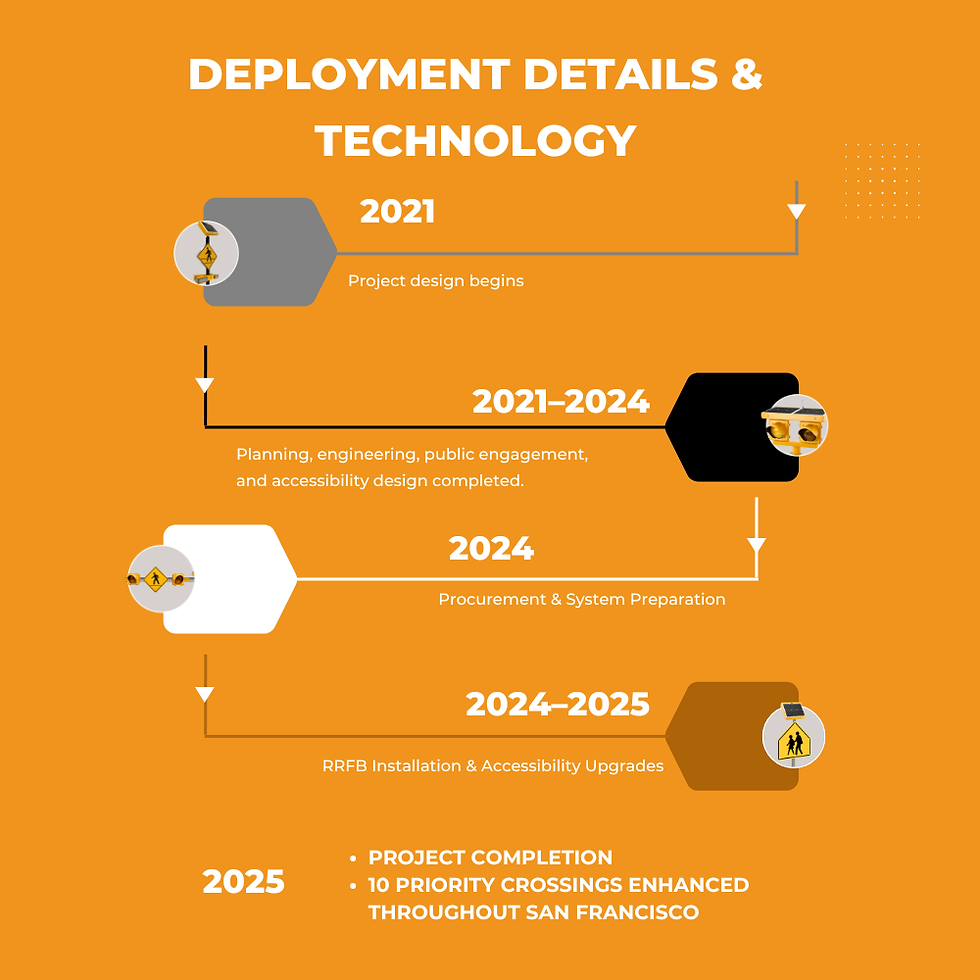
As part of San Francisco's Vision Zero strategy, the San Francisco Municipal Transportation Agency (SFMTA) implemented the WalkFirst Rectangular Rapid Flashing Beacons (RRFB) Project to improve pedestrian safety at ten crosswalk locations throughout the city.
The project introduced pedestrian-activated RRFB systems, accessible pedestrian signals (APS), and accessibility upgrades at key crossing locations. Several installations were located along San Francisco's High Injury Network, corridors identified as having elevated rates of severe and fatal traffic collisions.
The initiative demonstrates how targeted pedestrian infrastructure investments can improve visibility, increase driver yielding behavior, and support safer streets for all road users.
Project Background:
Vision Zero & WalkFirst
San Francisco launched its Vision Zero program with the goal of eliminating traffic fatalities and serious injuries while creating safer transportation networks for pedestrians, cyclists, transit users, and motorists.
The WalkFirst program identified locations where pedestrian improvements could have the greatest safety impact. Through ongoing safety analysis, SFMTA selected ten crossings for RRFB deployment based on pedestrian activity, crossing conditions, and safety priorities.
Three of the project locations were situated on the city's Vision Zero High Injury Network, where pedestrian safety improvements were considered especially important.
.png)
The Need for Enhanced Crossing Visibility
Many urban crossings rely solely on pavement markings and static signage. While these treatments establish legal crossing locations, they do not always provide enough visual emphasis to encourage consistent driver yielding.
Rectangular Rapid Flashing Beacons address this challenge by using highly conspicuous flashing LED indications that activate when pedestrians begin crossing.
Research from the Federal Highway Administration has shown RRFB systems can significantly improve driver awareness and increase yielding rates at uncontrolled crossings. Studies have documented yielding rates approaching 98% under favorable conditions.

Accessibility & Complete Streets Improvements
The WalkFirst RRFB Project extended beyond flashing beacon installation by incorporating accessibility upgrades designed to improve the pedestrian experience for all users.
Project improvements included:
-
Rectangular Rapid Flashing Beacons (RRFBs)
-
Accessible Pedestrian Signals (APS)
-
ADA-compliant curb ramps
-
Enhanced crosswalk visibility
-
Upgraded pedestrian infrastructure
-
These improvements support San Francisco's broader Vision Zero and accessibility goals by creating safer and more inclusive crossing environments.


.png)
JSF Technologies Product Capabilities
Projects such as San Francisco's WalkFirst initiative demonstrate the growing role of intelligent pedestrian safety systems in modern transportation networks.
RRFB systems provide municipalities with:
-
High-visibility pedestrian warning technology
-
Proven improvements in driver yielding behavior
-
Flexible deployment at uncontrolled crossings
-
Cost-effective alternatives to full traffic signals
-
Compatibility with accessibility requirements
-
Integration into Vision Zero safety strategies
RRFB solutions can be deployed at intersections, mid-block crossings, school zones, trail crossings, and other locations where pedestrian visibility is a concern.
Project Highlights
🚸 10 Crossings Upgraded
Priority pedestrian locations enhanced throughout the city.
♿ Accessibility Improvements
APS systems and ADA-compliant upgrades added at project locations.
⚠️ High Injury Network Focus
Multiple locations selected based on Vision Zero safety priorities.
🚦 Active Warning Technology
RRFB systems provide highly visible driver alerts when pedestrians are present.

Project Outcomes
The WalkFirst RRFB Project focused on improving pedestrian visibility and accessibility at priority crossing locations throughout San Francisco. The project delivered targeted safety improvements at ten crossings, including multiple locations on the city's High Injury Network.
Metric
Value
Source
Priority Crossings Enhanced
10
SFMTA WalkFirst Project
High Injury Network Locations
3
SFMTA WalkFirst Project
RRFB Installations Completed
10 Crossings
SFMTA WalkFirst Project
Accessibility Upgrades Added
APS + ADA Improvements
SFMTA WalkFirst Project

Conclusion
San Francisco's WalkFirst Rectangular Rapid Flashing Beacons Project highlights the value of proven pedestrian safety technologies within a comprehensive Vision Zero framework.
Through the deployment of ten RRFB-equipped crossings, accessible pedestrian signals, and accessibility enhancements, the city has improved visibility, strengthened driver awareness, and supported safer pedestrian movement throughout multiple neighborhoods.
As municipalities across North America continue to pursue Vision Zero objectives, projects like WalkFirst demonstrate how targeted RRFB installations can deliver measurable safety benefits while supporting more accessible and walkable communities.
Sources
WalkFirst Rectangular Rapid Flashing Beacons Project
https://www.sfmta.com/projects/walkfirst-rectangular-rapid-flashing-beacons-project
RRFB Proven Safety Countermeasure
Effects of Yellow Rectangular Rapid-Flashing Beacons on Yielding at Multilane Uncontrolled Crosswalks
https://www.fhwa.dot.gov/publications/research/safety/pedbike/10046/index.cfm
PedBikeSafe RRFB Countermeasure
https://www.pedbikesafe.org/pedsafe/countermeasures_detail.cfm?CM_NUM=54